What Voltage Does a Table Saw Need? A Simple Explanation
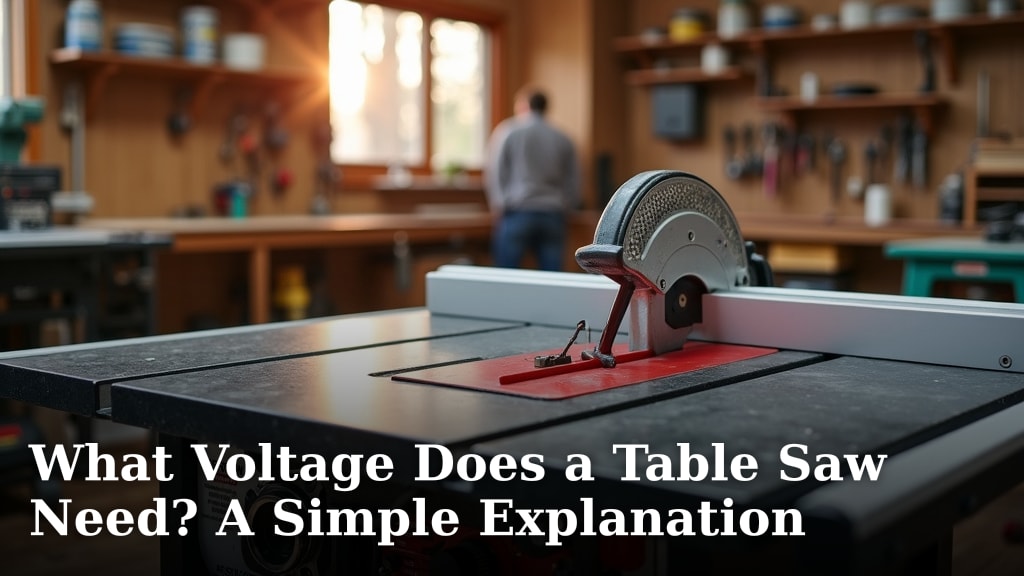
Most table saws you’ll find for home use run on standard household 120-volt power For portability and common tasks, a jobsite table saw is often the choice.. This is the same voltage that powers your lamps and TVs. Larger, professional-grade table saws, however, often require 240-volt power. This higher voltage provides more power for demanding cuts.
Understanding your table saw’s voltage needs is important for safe and proper operation. Using the wrong voltage can lead to poor performance or even damage to your saw. We’ve found that knowing this simple detail can save you a lot of headaches.
- Most home table saws use 120V.
- Heavy-duty or professional saws often need 240V.
- Voltage affects the power and performance of your saw.
- Check your saw’s manual or label for its specific voltage.
Let’s break down what voltage your table saw likely needs and what that means for your workshop.
Powering Your Cuts: Understanding Table Saw Voltage
When you’re ready to make those perfect cuts, your table saw needs the right amount of electricity. We’ve found that understanding your saw’s voltage requirements is key. It’s not just about plugging it in; it’s about ensuring your saw performs its best and stays safe. Let’s look at the common voltages and what they mean for your woodworking projects.
The Two Main Voltage Players: 120V vs. 240V
For most home workshops, the question of voltage usually boils down to two main numbers: 120 volts and 240 volts. Think of voltage like water pressure. More pressure (higher voltage) can push more water (power) through the pipes (the saw’s motor). You’ll see these numbers mentioned on your saw’s nameplate or in its manual.
120-Volt Table Saws: The Standard for Home Use
This is the voltage you’re probably most familiar with. Your table saw likely runs on 120 volts if it’s designed for a typical home garage or basement. This is the same power that comes out of standard wall outlets in your house. You can usually identify a 120V outlet by its plug, which typically has two flat parallel pins and a round ground pin.
Many people start with a 120V saw because it’s convenient and accessible. You don’t need special wiring or a dedicated circuit. If your saw is under, say, 1.5 horsepower, it’s almost certainly a 120V model. They’re great for smaller projects and lighter materials.
Pros of 120V Saws
- Easy to use: Plugs into standard household outlets.
- Widely available: Most smaller and mid-size saws are 120V.
- No special installation: You likely won’t need an electrician.
Cons of 120V Saws
- Less power: May struggle with very hard woods or thick materials.
- Breaker trips: Can sometimes overload a circuit if not properly managed.
240-Volt Table Saws: For Bigger Jobs and More Power
If you’re working with a larger, more powerful table saw, especially one with a motor over 1.5 or 2 horsepower, it might need 240 volts. This higher voltage provides significantly more power to the motor. Think of it like a V8 engine versus a four-cylinder – more grunt for tougher tasks.
These saws often come with a different type of plug that requires a dedicated 240V circuit. You might need to have an electrician install this if your workshop doesn’t already have one. This is common in professional shops or for serious hobbyists who do a lot of demanding work.
Pros of 240V Saws
- More power: Handles hardwoods, thick lumber, and repetitive cuts with ease.
- Better efficiency: Can run more powerfully for longer periods.
- Less strain on circuits: Often uses a higher amperage circuit, reducing tripping risks for heavy loads.
Cons of 240V Saws
- Requires special wiring: You may need an electrician to install the outlet.
- Less portable: Often part of a more permanent workshop setup.
- Higher initial cost: Saws requiring 240V tend to be larger and more expensive.
How to Find Your Table Saw’s Voltage Requirement
Don’t guess! Your table saw will clearly state its voltage needs. We found that checking the saw’s nameplate is the quickest way. This is a small metal plate, usually on the back or side of the motor housing, that contains all the important specifications.
You can also find this information in your owner’s manual. If you’ve lost the manual, a quick search online using your saw’s model number will usually bring up a digital copy. It’s really important to know this before you even think about plugging it in!
Checking the Nameplate
Look for a section that lists “Voltage,” “V,” or “Volts.” It will be clearly marked as 110V, 115V, 120V for standard power, or 220V, 230V, 240V for higher power. Sometimes, a saw might be dual-voltage, meaning it can run on either 120V or 240V, but this is less common for typical consumer models.
Consulting the Owner’s Manual
Your manual is your best friend when it comes to understanding your tools. It will have a specifications section that lists the required voltage, amperage, and wattage. If you’re unsure about any of the details, the manual is the first place to look.
What Happens If You Use the Wrong Voltage?
Using the wrong voltage can lead to a few undesirable outcomes. It’s not just a minor inconvenience; it can affect your saw’s performance and even damage its components. We’ve learned that understanding these risks is crucial for safety and tool longevity.
Under-Volting: Not Enough Power
Plugging a 120V saw into a 240V outlet (which is rare but possible with adapters) or trying to run a 240V saw on a 120V circuit (if it’s even designed to do so) can lead to under-volting. A 120V saw on a weak 120V circuit might also experience this. The motor will likely run slower and weaker. It might overheat because it’s trying to do more work than it has power for.
This is like trying to run a marathon after only eating a small snack. The motor can get very hot, which is a fire hazard. It can also damage the motor windings over time. For a 240V saw that’s incorrectly wired to 120V, it simply might not start, or it will be incredibly underpowered.
Over-Volting: Too Much Power
It’s less common, but theoretically, if you were to plug a 120V saw into a 240V outlet without it being a dual-voltage saw, you’d be sending too much electricity its way. This could overheat and burn out the motor very quickly. It’s like trying to drink from a fire hose – it’s too much too fast and things break. For the most part, however, table saws are designed for specific voltage inputs, and you won’t be able to plug the wrong one in due to the different outlet configurations.
Matching Your Saw to Your Workshop Power
When you’re buying a table saw, think about your workshop’s electrical capabilities. If you only have standard 120V outlets and no plans to upgrade your wiring, a 120V saw is your best bet. They are perfect for DIYers and hobbyists who work with softer woods or don’t need to make extremely demanding cuts frequently.
If you plan on buying a larger, more powerful saw, or if you already know you’ll be cutting dense hardwoods regularly, then a 240V saw might be in your future. Be prepared to potentially invest in a new circuit from an electrician. Many experts recommend having a dedicated circuit for a table saw, regardless of voltage, to prevent tripping breakers when you’re in the middle of a project.
Table Saw Voltage vs. Amperage and Wattage
Voltage is just one piece of the power puzzle. You’ll also see amperage (Amps) and wattage (Watts) listed. Amperage is the rate of electrical current flow, while wattage is the total power consumption (Voltage x Amperage = Wattage).
A higher amperage on a 120V circuit means the saw draws more current, which is why it might trip a breaker. A 240V saw often draws less amperage than a comparable 120V saw for the same amount of power, making it more efficient. For example, a 120V saw might be 15 Amps, while a 240V saw might be 10 Amps, but because the voltage is doubled, it delivers more overall power.
| Metric | What it Measures | Analogy |
|---|---|---|
| Voltage (V) | Electrical pressure or “push” | The force pushing water through a hose |
| Amperage (A) | Electrical current flow | The volume of water flowing per second |
| Wattage (W) | Total electrical power used | The overall “work” the water can do |
Checklist: Getting Your Table Saw Power Right
To make sure you’re set up correctly, keep these points in mind:
- Identify your saw’s voltage on the nameplate or manual.
- Determine your workshop’s available power (standard outlets or 240V circuits).
- Ensure your circuit breaker is rated correctly for your saw’s amperage.
- Use the right plug and cord designed for your saw’s voltage and amperage.
- Consider a dedicated circuit for your table saw to avoid power interruptions.
- If in doubt, consult a qualified electrician for workshop wiring advice.
Conclusion
You now understand that most home table saws run on standard 120V power, while larger, more demanding saws often need 240V. Knowing your saw’s voltage is key for safe operation and peak performance. Always check the nameplate or manual for the exact requirement before plugging anything in. If you’re unsure about your workshop’s wiring or need to upgrade for a 240V saw, don’t hesitate to consult a qualified electrician. Getting the power right ensures your table saw is a reliable partner for all your woodworking projects.
Frequently Asked Questions
Can I plug a 120V table saw into a 240V outlet?
No, you should never plug a 120V table saw directly into a 240V outlet. Doing so would send too much voltage to the motor, likely causing it to overheat and burn out very quickly. The plug types are also different, preventing a direct connection for most models.
What happens if my table saw doesn’t have enough power?
If your table saw is underpowered for the cut you’re making, you might notice the motor slowing down considerably. It could also start to overheat, which is a safety concern and can damage the motor over time. This often means the saw is either not getting enough voltage or the circuit is overloaded.
Do I need a special outlet for a 120V table saw?
Generally, no. Most 120V table saws are designed to plug into standard household outlets, the same ones you use for lamps or small appliances. You just need to ensure the outlet is on a circuit that can handle the saw’s amperage draw without tripping the breaker.
How can I tell if my workshop has 240V power?
You’ll typically see larger, differently shaped outlets in your workshop if you have 240V power available. These outlets often have more prongs than standard 120V outlets. You can also check your main electrical panel for circuit breakers that are double-width, indicating a 240V circuit.
Is a 240V table saw always more powerful than a 120V one?
Not necessarily always, but typically yes for saws of comparable size and motor design. A 240V saw can deliver more power efficiently, especially for demanding tasks. However, a high-end 120V saw might outperform a very basic 240V model. It’s the combination of voltage, amperage, and motor engineering that determines the saw’s true power.