What to Look for in a Table Saw? A Straightforward Guide

Choosing the right table saw depends on your projects and budget. You’ll want to look for a saw with a powerful motor, a sturdy fence, and safety features. This guide will help you find one that fits your needs.
When you’re looking at different saws, think about the type of wood you’ll cut and how often you’ll use it. A saw that’s great for occasional DIY projects might not be enough for a pro woodworker. We found that focusing on durability and ease of use is key for most shoppers.
- Motor power for different cuts.
- Fence accuracy for straight lines.
- Blade options for various materials.
- Safety guards and features.
- Overall build quality and stability.
Let’s walk through exactly what to consider to make sure you pick a table saw you’ll be happy with for years to come.
Choosing the Right Table Saw for Your Workshop
Selecting the ideal table saw can feel like a big decision. You want a tool that helps you make precise cuts. It should also be safe and reliable for your woodworking projects. We’ve researched what matters most for everyday shoppers. For extreme precision with large panels, you might consider a sliding table saw.
Think about the types of projects you tackle. Are you building a birdhouse or a dining table? Your answer helps narrow down the choices. We found that understanding a few key features makes the process much simpler.
Motor Power: The Engine of Your Saw
The motor is the heart of your table saw. It drives the blade and determines its cutting power. More power generally means easier cuts through thicker or harder woods. It also helps prevent the blade from bogging down.
Horsepower Matters
Table saws come with motors ranging from 1 to 2 horsepower (HP) for smaller models. Larger, professional saws can have 5 HP or more. For most home woodworkers, a motor between 1.5 and 2 HP is a good starting point.
If you plan to cut hardwoods like oak or maple frequently, lean towards the higher end of that range. For softer woods or occasional use, a 1 to 1.5 HP motor might be sufficient. We found that underestimating motor needs can lead to frustration.
Amperage and Voltage
Motor power is also related to amperage and voltage. Most saws for home use run on standard 120-volt household power. Higher horsepower saws might require 240-volt circuits, which you may need an electrician to install.
Amperage indicates how much power the motor draws. A higher amperage on a 120-volt saw often means more torque. This helps the saw maintain speed under load. Look for saws with a 15-amp motor if you’re using standard outlets.
The Fence: Guiding Your Cuts
The fence is your guide for making straight, repeatable cuts. A good fence glides smoothly and locks into place without shifting. It’s essential for accuracy and safety. A wobbly or inaccurate fence can lead to poor results and dangerous situations.
Types of Fences
There are several types of fences. The beveled edge fence is common on less expensive saws. It’s essentially a metal bar that slides along the front and back rails. It can be prone to misalignment.
A beak-style fence or racking fence is much better. These fences have a wider gripping surface. They lock down securely on both the front and rear rails of the table. This design offers superior stability and accuracy.
We found that a fence with a scale printed on it is a nice convenience. It allows you to quickly set the distance from the blade to the fence without measuring. Make sure the scale is easy to read and accurate.
Fence Travel and Alignment
Consider how far the fence can travel. This determines the maximum width of material you can rip. Most fences allow for rips up to about 24 inches or 30 inches. Ensure the fence locks parallel to the blade. Many saws require some adjustment to achieve this.
The Table and Extension: Stability and Support
The table provides the work surface for your saw. A larger, heavier table absorbs vibrations better. This leads to more accurate cuts. Extension wings on the sides can increase your work area.
Table Material and Size
Table saws often have cast-iron tables. Cast iron is heavy and durable, which helps reduce vibration. Some smaller or portable saws might have aluminum tables. While lighter, they can be more prone to vibration.
A larger table gives you more room to maneuver larger pieces of wood. Look for a table with smooth, flat surfaces. Check for pre-drilled holes for mounting jigs or accessories. The table’s dimensions are important for supporting your work.
Extension Wings and Stands
Many table saws come with extension wings. These bolt onto the sides of the table. They increase the usable surface area. This is very helpful when cutting large sheets of plywood or long boards.
Portable table saws often sit on stands. Some stands are basic legs, while others have wheels for mobility. Wheeled stands can be very useful if you need to move the saw around your garage or workshop. Consider the overall footprint and stability of the stand.
Blade and Blade Control: Making the Cut
The blade is what does the cutting, and how you control it is vital. Blade height and bevel adjustments should be smooth and easy to operate.
Blade Height Adjustment
You need to be able to adjust the blade height. This is important for safety and cut quality. For most cuts, you want the blade to extend about 1/8 to 1/4 inch above the wood. This allows for a cleaner cut.
Look for saws with a handwheel for raising and lowering the blade. These are typically smoother and easier to use than lever-style adjustments. Some saws also allow you to easily tilt the blade for making bevel cuts.
Bevel Cuts and Angle Accuracy
Bevel cuts are angled cuts, often used for trim work or furniture. Your saw should have a mechanism for tilting the blade. Most saws tilt up to 45 degrees. Check that the bevel scale is accurate and easy to lock in place.
We found that saws with a positive detent at 90 and 45 degrees are very convenient. This means the blade locks firmly into these common angles. It makes setting up for square or beveled cuts much faster and more reliable.
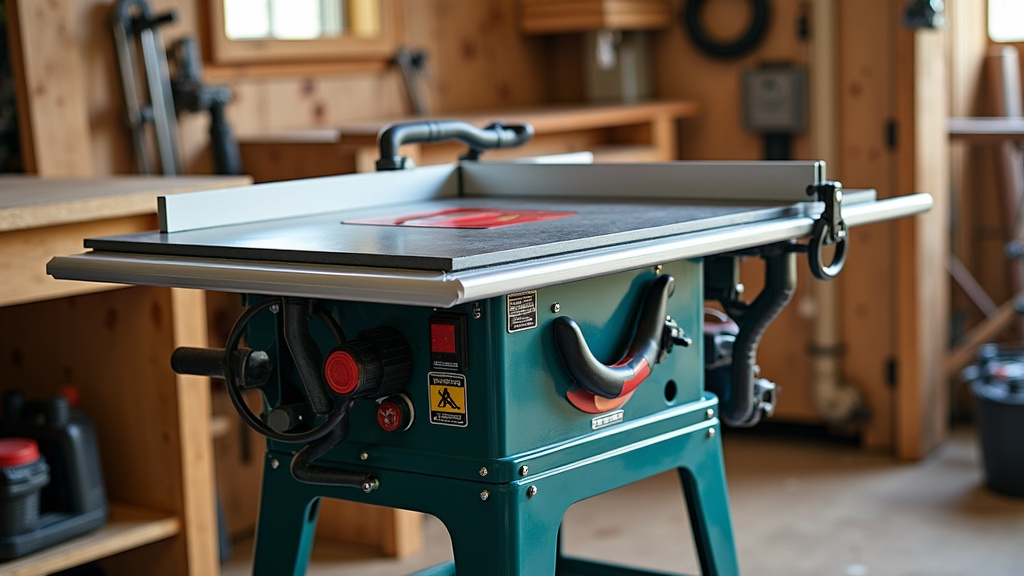
Safety Features: Protecting Yourself
Table saws are powerful tools, and safety should always be your top priority. Modern saws come with several built-in safety features. Make sure your chosen saw has them.
Blade Guard and Riving Knife
A blade guard covers the top of the blade. It helps prevent accidental contact and can direct dust away. It should be easy to remove for certain operations, like dado cuts.
A riving knife is a thin piece of metal behind the blade. It separates the wood after the cut. This significantly reduces the chance of the wood pinching the blade and kicking back. We found that a splitter, which is similar to a riving knife, is also a key safety item.
Anti-Kickback Pawls and Push Sticks
Anti-kickback pawls are small metal teeth that dig into the wood if it starts to move backward towards the blade. They help prevent dangerous kickback. Many saws include these as part of the blade guard assembly.
Always use a push stick or push block when working with smaller pieces of wood. These tools help keep your hands a safe distance from the blade. Most table saws should come with at least one. If not, they are an inexpensive and essential accessory to purchase.
Emergency Stop Button
Some higher-end saws feature a large, easy-to-access emergency stop button. Pressing this button immediately cuts power to the saw. This can be a lifesaver in unexpected situations.
Dust Collection: Keeping Your Space Clean
Table saws produce a lot of sawdust. Effective dust collection is important for your health and the cleanliness of your workshop. Most saws have a port where you can attach a shop vacuum or dust collector.
Look for a saw with a large dust collection port, ideally 4 inches in diameter. Smaller ports may not handle the volume of dust effectively. Some saws have enclosed bases that help direct dust toward the port.
Many experts say that good dust collection is crucial for maintaining a safe and healthy working environment (OSHA). Fine sawdust can be a respiratory irritant. Keeping it contained also means less cleanup later.
Portability and Storage: Fitting Your Space
If you have limited workshop space, portability is a key consideration. Smaller, lighter saws are easier to move and store. Some are designed to fold up.
Portable table saws are often lighter and smaller. They might have integrated stands with wheels. These are great for moving between job sites or tucking away when not in use.
Contractor saws and hybrid saws are usually heavier and more robust. They might offer better stability but are harder to move. Consider how often you’ll need to relocate your saw. Measure your available space carefully.
Quick Checklist for Your Table Saw Search:
- Motor Power: Aim for 1.5 HP or more for hardwoods.
- Fence Type: Look for a stable racking or beak-style fence.
- Table Surface: Cast iron is preferred for vibration damping.
- Safety Gear: Ensure it has a riving knife and blade guard.
- Dust Port: A 4-inch port is ideal for efficient collection.
- Blade Control: Smooth handwheel adjustments for height and bevel.
Conclusion
You’re now equipped to make a confident table saw decision. Remember to weigh motor power, fence accuracy, and safety features against your project needs and budget. A sturdy table and smooth blade control will ensure precision for years. We found that prioritizing build quality and ease of use leads to the most satisfying purchase. Take your time, review our checklist, and you’ll find a table saw that truly fits your workshop.
Frequently Asked Questions
What’s the minimum horsepower I need for a table saw?
For most home woodworkers, a 1.5 to 2 horsepower motor is a good starting point. If you plan on cutting hardwoods frequently, aim for the higher end of that range. For softer woods or occasional tasks, 1 to 1.5 HP might be enough.
How important is the fence on a table saw?
The fence is critical for making straight and repeatable cuts. A wobbly or misaligned fence will lead to inaccurate work and can be a safety hazard. Look for a fence that locks down securely and moves smoothly.
What’s the difference between a riving knife and a splitter?
A riving knife and a splitter serve a similar purpose: to keep the wood kerf open after the blade passes. This dramatically reduces the risk of kickback. We found that a riving knife is generally preferred for its stability and ease of adjustment.
Do I really need a 4-inch dust collection port?
A 4-inch dust collection port is ideal for efficiently removing sawdust. Smaller ports may struggle with the volume generated by a table saw, leading to dust buildup and a messier workspace. Good dust collection also improves air quality.
Are portable table saws good enough for DIY projects?
Yes, portable table saws can be excellent for many DIY projects, especially if you have limited space or need mobility. They offer many of the same core functions as larger saws but are lighter and easier to store or move around your workshop.